note
May 2, 2026 / 13 min read
The Prize That Stole the Pencil
On the overjustification effect, reward, and how a private reason can be replaced while the hand still keeps moving.
- filed under Essay / Psychology / Work / Attention
- author Shuvam Pandey
writing
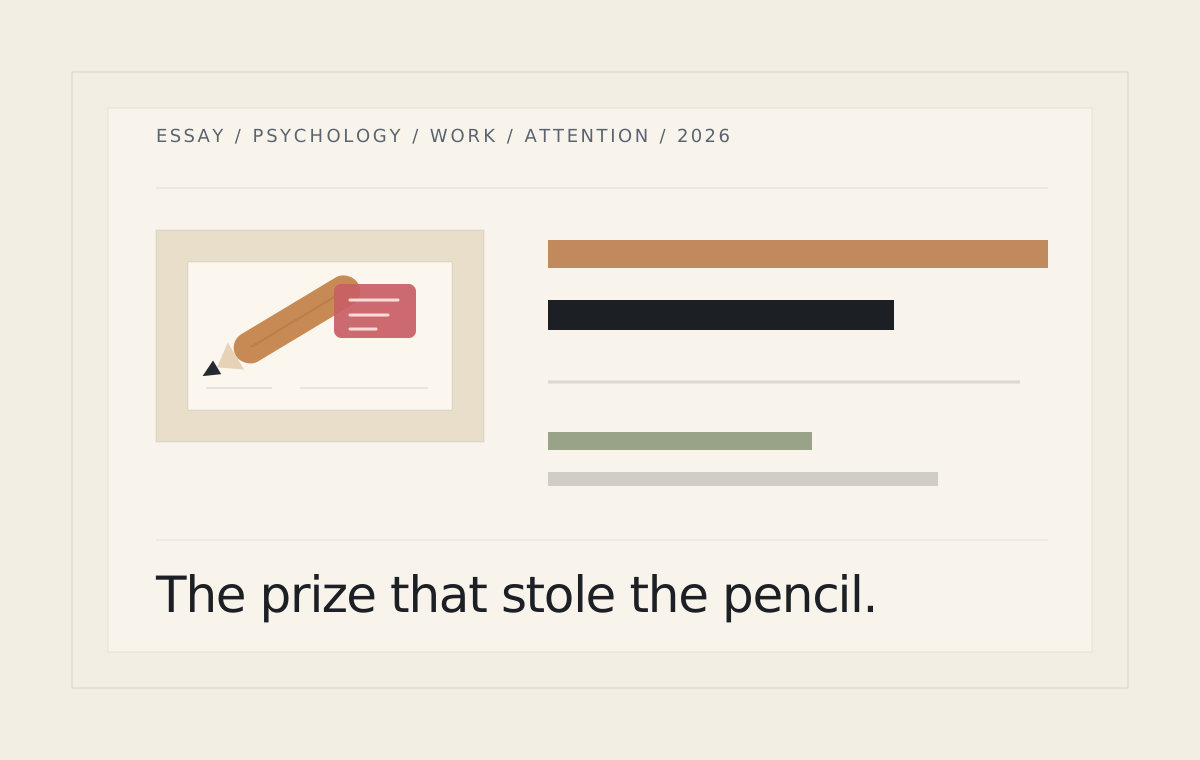
There is a child at a table.
The paper is blank, but only to us. To the child, it is already full of weather. Houses are waiting. Suns are waiting. A tree may become a person. A person may become a bird. Nothing has to explain itself yet.
The child draws for no audience yet. No marks, no praise, no future proof. Something inside wants a way out, and the hand obeys.
Then an adult enters with a prize.
At first, it looks like kindness.
Draw, and you will get this.
The child draws. The adult smiles. The reward is given. From outside, everything seems to have worked. A wanted behavior increased. A good habit was encouraged. The room became measurable.
But something small may have been moved.
Before the prize, the child’s reason was private:
I draw because I like drawing.
After the prize, another reason appears:
I draw because drawing gets me something.
That second reason is not harmless just because it is useful.
Sometimes it does not stand beside the first reason.
Sometimes it replaces it.
What the prize changes
This is the overjustification effect: the strange possibility that rewarding people for what they already love can teach them to love it less.
The point is not that rewards are always bad. It is that human beings are not machines. We do not simply act. We interpret ourselves acting. We watch our own hands and ask, quietly:
Why am I doing this?
And if the world answers loudly enough, we may believe it.
The experiment
In 1973, psychologists Mark Lepper, David Greene, and Richard Nisbett studied preschool children who already liked drawing. Some children were told they would receive an award for drawing. Some received no award. Some received a surprise award afterward.
Later, when the children were free to choose what to do, the children who had expected the award showed less interest in drawing than the others.
The prize had not increased love. It had changed the meaning of the act.
The terrifying part is how little appears to vanish. The child still knows how to draw. The hand still works. Only the old reason has moved out.
And a person can continue doing something long after the reason has died.
The prize had not increased love. It had changed the meaning of the act.
I know this damage
I know this in a smaller, uglier way than I would like.
There was a time I made things because the problem had a shape and I wanted to understand it. That was all. A system did not work. A page was unclear. A test failed. A behavior was hidden somewhere under the surface, and I wanted to find it because finding it felt like placing my hand on something true.
Then, slowly, the imagined room changed.
Before I opened the file, someone was already there.
A future reader.
A senior.
A reviewer.
A person with taste.
A person who would decide whether the work proved anything about me.
I would sit down to build, and before the first decision, I was already arranging evidence. I was not asking, what is the cleanest shape this thing can take? I was asking, what will this look like from outside?
That question can still produce good work, which is exactly why it is dangerous.
The work may become sharper, more polished, more defensible. The outside may improve. The vocabulary may mature. The proof may become stronger.
Underneath, the first motion changes. Attention becomes self-defense. Curiosity becomes a trial. The work begins with the witness already seated.
And if this goes on long enough, you may still be productive, still praised, still improving, while becoming less able to tell whether you want the thing itself or only the safety of being seen wanting the right thing.
The reward does not steal loudly
Nothing dramatic happens when a thing becomes overjustified.
No door closes.
No talent vanishes.
No one wakes up and says, today I stopped loving what once kept me alive.
The change is quieter.
A student who once read because books opened hidden rooms begins reading only for exams.
A builder who once loved making systems clean begins building only to be evaluated.
A writer who once wrote because silence became unbearable begins writing only to be seen.
A kind person who once helped without calculation begins to feel the ugly little question arrive before every act of care:
Will anyone notice?
The pencil is still there.
The hand still remembers.
But the first reason has been pushed behind glass.
When the prize colonizes the act
The prize may not create the action. It can still colonize it.
Colonization does not always destroy the old thing immediately. That would be easier to recognize. The land remains. The roads remain. The crops still grow. People still wake, work, marry, cook, laugh, bury their dead. From a distance, life appears to continue.
But the names change.
The maps change.
The center of authority moves somewhere else.
The old language is still spoken at home, but not where power lives.
Something similar can happen inside a person. The drawing continues, but its capital has moved. The work continues, but it now answers to another flag. The hand still moves across the page, but the page no longer belongs entirely to the child.
The damage hides so well because the outer metrics can improve. The child draws more. The student scores higher. The worker produces faster. The creator posts consistently.
The system looks successful because the behavior remains.
But the homeland of the behavior has changed.
The act still exists.
Its ownership has been transferred.
I am not sure this can be undone
I do not know whether the first reason always comes back. I do not know whether love, once replaced by evidence, can be recovered simply by wanting recovery. I do not know whether sitting down again with pure intention is even possible, because intention itself arrives watched, trained, nervous, already asking whether it is pure enough.
Some first reasons return. Some return damaged. Some never return at all. There may be pencils we do not touch again because the old door closed so quietly that by the time we notice, we no longer know how to enter without performing entry.
This is the honest darkness of it.
Awareness does not save everything. Not every lost thing was waiting for us to become wise. Some things leave because we were careless, some because we were rewarded, some because the world called them childish until we became ashamed of needing them.
And shame is a very efficient teacher.
The modern prize is not a medal
The prize today does not always look like a certificate.
Sometimes it looks like a phone face-down on the table while you try to work, glowing once, then again, each light quietly asking whether the thing you made has begun to exist yet.
That is all.
A small rectangle.
A pulse.
A number changing.
A number not changing.
No one enters the room with a ribbon. No one says, I am here to replace your private reason with a public one.
The replacement is gentler than that.
You write a sentence, then imagine its reception.
You build a thing, then imagine its proof.
You learn something, then imagine where it can be displayed.
You feel something, then imagine whether it can become language.
Soon the witness arrives before the experience.
Soon nothing is allowed to happen until it has considered its future audience.
Vanity is not the whole story.
It is fear.
The fear of being unseen.
The fear of wasting effort.
The fear that private meaning is not real until the world returns a signal.
And the world is always ready to exploit that fear.
The cruelest success
The most dangerous rewards are not the ones that fail.
They are the ones that work too well.
A school can raise marks and kill curiosity.
A company can increase output and kill craftsmanship.
A platform can grow creators and kill creation.
A family can reward obedience and kill sincerity.
A person can become impressive and lose contact with the part of them that once wanted anything without needing it to count.
The outside improves.
The inside thins.
And because the outside improves, no one calls it damage.
The overjustification effect is not only a theory about motivation. It is a theory about meaning.
It asks a question more frightening than how do we make people do more?
It asks:
How do we stop ourselves from destroying the desire already there?
The first reason
Every living thing in us has a first reason.
A first reason is not always noble. It may be childish, clumsy, hungry, even foolish. But it is ours before it becomes strategic.
The first reason is why the child drew before anyone praised the drawing.
Why someone learned code before it became a portfolio.
Why someone read before reading became proof of intelligence.
Why someone cared before kindness became identity.
Why someone loved before love became a record of effort.
The first reason is fragile because it is usually quiet.
It cannot compete with applause.
It cannot compete with comparison.
It cannot compete with the clean violence of numbers.
So if we do not protect it, the world gives us louder reasons. And because they are louder, we mistake them for truer ones.
This does not mean we should reject every reward. People deserve to be paid. Work deserves to be recognized. Children deserve encouragement. Hunger is not holiness.
But even the right reward must be held carefully.
Be paid.
But do not be purchased.
One boy, one page
I keep thinking of a boy who has written three lines in a notebook and then stopped.
The lines are probably bad. That is not the problem.
The problem is that after the third line he has already left the room. He is imagining the finished thing. The title. The reader. The person who will think he is deep. The person who will not. The person who will compare this page to the better thing he wrote before. The person who will silently decide he was never what he seemed.
His hand is still above the paper.
But he is no longer with the sentence.
He is standing in a courtroom built entirely out of imagined faces.
Nothing has happened yet.
Already, he is defending himself.
The prize can do this even before it arrives.
It teaches the mind to audition for permission.
The question that should frighten us
The frightening sentence is not:
I do not want to do this anymore.
That may be honest. Not every lost interest is a tragedy. Some things end because we grow.
The frightening sentence is:
Why would I do this if no one rewards me?
Because sometimes hidden inside that sentence is a history.
The person may never have cared. But they may have cared before care became content, learned before learning became ranking, built before building became proof, loved before love became performance.
The prize did not have to create the action. It only had to rename it.
The child again
Return to the child at the table.
The child is older now.
That always happens.
Perhaps the child became efficient, impressive, punctual, polished, useful, visible. Perhaps the child forgot the feeling of paper as a small world.
Or perhaps somewhere under the grades, metrics, praise, pressure, and performance, the first reason survived.
Not untouched.
Nothing survives untouched.
But alive.
A little shy.
A little suspicious of being made useful too quickly.
A little tired of prizes.
The work of a life may be to accept recognition without handing it the keys.
To let the world honor the work without letting honor become the reason the work exists.
The child did not need the prize to love drawing.
The child needed a world careful enough not to interrupt the love already there.
And maybe that is true for more of us than we admit.
We are full of pencils we have not touched in years because somewhere along the way, the prize became louder than the page.
The work now is quiet.
To sit again.
To make something without immediately asking what it proves.
To let the first mark be awkward.
To let the old reason return slowly, if it returns.
And this must be said without comfort:
Some old reasons will not return.
Some pages will stay blank.
Some part of the child may remain unreachable, not dead exactly, but living in a country whose language we can no longer speak.
Still, there is the table.
Still, there is the hand.
Still, there is the page.
And perhaps the first honest mark is not the one that brings the old love back.
Perhaps the first honest mark is only this:
I know what was taken.
I know I helped take it.
I am not drawing to be forgiven.
I am drawing because, before the award, before the applause, before the bright machinery of evaluation entered the room, there was once a reason no one had given me.
And for one unmeasured second, I would like to sit near it again.
next note
The Last Day Has No Date
On undated grief, vanishing friendships, lost selves, and the ordinary days that become endings without telling us.